From Workplace Frustrations to a Thriving Financial Community.
Source: Vidiq
In every workplace, challenges are inevitable. They come in different forms. It can be in form of bureaucracy, inefficiency, limited resources, or missed opportunities. But I have always believed that an entrepreneurial mindset means seeing opportunities where others see obstacles, and that philosophy has shaped the way I approach life and work. According to University Canada West, this kind of mindset is not only for those who want to start their own business but also for those who want to succeed in life.
Several years ago, a situation arose in my office that tested this belief, where i turning challenges into opportunities. Many of my colleagues were frustrated because they couldn’t access loan facilities from commercial banks. The process was riddled with bureaucracy—endless paperwork, delays, and requirements that most staff could not meet. Instead of waiting endlessly or giving in to discouragement, I asked myself a simple question:What if we created our own solution?
That question became the seed of an idea that grew into something far bigger than I initially imagined.
Identifying the Opportunity in a Challenge
I realised that the problem was not a lack of money; it was access to it. We had capable and hardworking employees who needed financial support for emergencies, investments, or family needs. If traditional institutions were not going to meet that need, then perhaps we could.
Drawing on my entrepreneurial mindset, I proposed forming a cooperative society within the organisation. At first, some colleagues were sceptical. As an entrepreneur, I trust my vision, but I’m not deterred by setbacks or criticism. My confidence allows me to stay focused on my goals and keep moving forward to this day. Starting something new always comes with doubt. But I knew that if I could clearly communicate the benefits of the cooperative to members, pool resources, grant ease access to loans, and ensure collective ownership, the idea would gain traction. That is precisely what happened.
Building with Creativity, Problem-Solving, and Resilience
Launching the cooperative required more than just an idea. It required action. I began by:
Setting up a clear structure .Setting up a clear structure: Defining rules for contributions, loans, and repayments to ensure transparency and trust.
Winning buy-in: Meeting colleagues one-on-one, listening to their concerns, and explaining how this solution was in their best interest.
Taking the lead: Volunteering to coordinate the initial setup, manage records, and organise meetings.
There were challenges, of course. Some doubted whether members would contribute consistently. Others feared mismanagement of funds and inefficiencies. But I stayed resilient, emphasising accountability and proper governance, and I took the lead on setting up the society. Indeed, my proactiveness has made me stand out, as I have been the president since 2014.
From a Small Start to 50 million Naira in Contributions
What began as a small initiative gradually grew. More staff joined, confidence increased, and the cooperative society expanded rapidly. Before long, I was elected President of the Cooperative, entrusted with leading and managing this collective effort.
Today, our cooperative has over 100 active members and has grown to a remarkable milestone of over 50 million naira in total member contributions. This growth is not just about money—it represents trust, innovation, and the power of collective problem-solving.
Lessons on Entrepreneurial Mindset at Work
Looking back, this experience reinforced many lessons regarding entrepreneurship, where turning challenges into opportunities, seven within a corporate environment:
See challenges as opportunities. Challenges often hide untapped possibilities.
Be proactive. Please do not wait for solutions, but create them. This hands-on approach helps you develop a solution-oriented attitude.
Win trust through accountability. Transparency is the backbone of any collective venture.
Growth mindset: One could learn and improve through effort and experience, even without formal business training. This mindset of continuous learning, self-reflection, and embracing new opportunities is crucial for an entrepreneur.
Lead with resilience. Every new idea faces resistance, but persistence builds momentum. Learned to view setbacks not as failures but as learning opportunities to adapt and pivot your approach.
Think beyond self. True entrepreneurship often benefits not just you, but others around you.
Networking and collaboration. The value of building relationships. This experience is a lesson on how to leverage a support system and exchange ideas.
Financial literacy: Managing a cooperative society with over 100 members will force one to learn basic financial principles, such as budgeting, managing cash flow, and tracking sales.
Conclusion
No matter your career path, your entrepreneurial mindset will help you lead a more productive life and also help you in turning challenges into opportunities. The story of our cooperative is more than a financial milestone for me. However, it is proof that innovation and resilience can turn office challenges into opportunities and also adapt to meet the needs of a constantly changing market. By applying an entrepreneurial mindset—identifying inefficiencies, proposing creative solutions, and taking the lead—I was able to make a real impact in the lives of our members.
If there is one message, I would leave with anyone reading this, it is this: Do not just wait for opportunities.
This article covers business and personal growth, connected due to the author’s strong interest in both concepts. Business growth is when a business reaches the level of expansion and pursues additional options to earn more profit. It is achievable when business owners and environmental factors determine what happens to a firm’s success.
In addition, businesses experience growth when there is no agent and the principal issues. The industry is expected to grow when its customer base is expanded, revenue increases due to several business models. Also, strategies employed or when different products are produced after researching the market to know the need of consumers.
Personal growth involves both comprehending and pushing oneself to reach their full potential. It can encompass adopting new habits, hobbies, skills, and approaches to accomplish one’s objectives.. It can also mean continually examining who you are becoming and your plans to attain that level.
Growth is not just about gaining market share but also involves engaging in social activities. This means a surviving company’s success relies on how well it serves its wider stakeholders and increases social welfare (Ward, 2020).
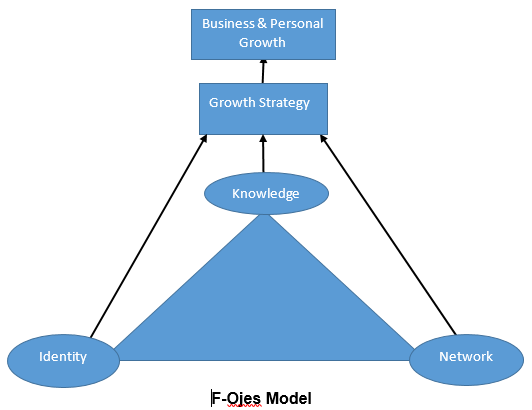
Numerous studies have explored business creation, operation, and management (Santamaria, 2018; Birley & Westhead, 1993; Rosa, 1998; Iacobucci & Rosa, 2010). However, this book has identified an F-Ojes Model consisting of three main business and personal growth pillars.
Component of this model tested
Successful businessmen and women have knowingly or unknowingly tested and applied the components of this business and personal model. It has helped them achieve success and expand their businesses.
Amancio Ortega created the Inditex Fashion Group and Zara chain store to fulfil his business and personal ambitions. He implemented this strategy by reinvesting billions of dollars in dividends into real estate and further expanding his business. As a result, both he and his company have thrived, with Zara having branches and offices worldwide. He was even once the wealthiest man in Spain.
Ortega’s leadership style involves actively listening to employees and clients and recognizing them as essential members of his business network. He prioritizes their input and ideas to ensure the business’s success. Ortega kept manufacturing and pricing tasks in-house to prioritise the business’s best interests.
As he listened to employees’ suggestions, he was able to design unique brands. It has helped him integrate their opinions and views into the organization’s success. A network can do this for someone who receives vital information from the immediate environment.
Several scholars have investigated different models for business growth. Still, this book looked at the model by Churchill and Lewis (1987), which is relevant to small and growing businesses as stated in the five stages of company development. According to Lewis and his friend.
The stages are:
Existence
This is related to garnering customers and delivering product or service.
Survival
This means companies have demonstrated that they are workable business entities, with a big question as to whether there is sufficient money for the firm to break even and remain in business.
Success
This has to do with the decision challenges encountered by owners of the business as to whether to exploit the firm’s achievement and expand or keep the firm stable and profitable, providing a base for alternative owner activities.
Take -Off
It means how to make the firm proliferate and finance its growth..
Resource Maturity,
With its size and management advantages, the company can become a strong market force if it keeps its entrepreneurial spirit.
According to Lewis, the model can be helpful for owners during the initial stages of their businesses. As a valuable tool for business owners, the model facilitates task allocation and enables the adjustment of management positions. It also proves beneficial for accountants and consultants in identifying issues and offering solutions to smaller enterprises.
A business or individual who desires business and personal growth should apply the three pillars that make men great. Expanding customer base, increasing revenue, producing more, and going global can help achieve goals.
In line with Premaratne, the success of business enterprises and individuals depends on personal networks (Premaratne, 2001). Still, this book discusses identity and knowledge about current information technology and the knowledge-based economy.
In this book, the author has introduced the F-Ojes Model, which has three main pillars. The first pillar is IDENTITY; the second is represented by the letter K, which stands for KNOWLEDGE. Lastly, the third and final pillar is represented by the letter N, which denotes NETWORK.
The author has listed certain pillars that resemble self-determination assumptions. These pillars relate to the requirements that individuals need to fulfil before achieving psychological growth. Find them below:
Autonomy
This is when the expectation is that individuals control their actions and objectives and feel a sense of ownership.
Competence
This is where the requirement is for people to gain mastery of tasks and learn diverse skills. Believing in your skills increases the likelihood of taking action towards achieving your goals.
Connection
This is where the requirement is for people to relate to other people across the network. When people experience a sense of belonging and attachment to others, they can see self-determination to achieve things.
Today, one cannot do without any of these technology like IoT, Cloud computing, Drone technology and Artificial Intelligent. If combine this technology with F-Ojes Model, it will surely position businesses and individuals.
References
Birley, S. and Westhead, P. (1993). A comparison of new businesses established by “novice” and “habitual” founders in Great Britain. International Small Business Journal, 12, 38-60.
Iacobucci, D. and Rosa, P. (2010). The Growth of business groups by habitual entrepreneurs: The Role of Entrepreneurial Teams. Entrepreneurship Theory & Practice, 34,351-373.
Premaratne, S.P.,(2001). Networks, resources, and small business growth: The experience in Sri Lanka. Journal of small business management, 39(4), pp.363-371.
Rosa, P. (1998) Entrepreneurial processes of business cluster formation and growth by “habitual” entrepreneurs. Entrepreneurship Theory and Practice, 22, 43–62.
Santamaria, S. (2018). Company growth or business growth? Business group formation as an entrepreneurial growth strategy. https://business.uc3m.es /seminarios/ filesem1542013693.pdf (Accessed 2nd October 2022).
Ward, A.M (2020). Finance: Theory and Practice, Chartered Accountants Ireland
Why you must investment in real estate in Nigeria are enormous is a question that needs answer. In an unpredictable time like this when the economy of Nigeria is being blighted by inflations and interest rates are reaching for the sky, real estate has become a suitable and top investment with which to cushion the impact of the harsh economy on your financial future.
Through real estate, you can enjoy amazing returns on investment and leverage real estate to build enviable wealth. Below are the five top reasons why real estate investment being the right investment for you in an austere time like this.
Real Estate Delivers Higher Returns Than the Stock Market with Less Volatility
Real estate is not subject to the kind of volatility that plagued stock markets around the world. Your property investment appreciates in value as the market improves, thus giving you the edge to build equity. However, in the stock market, the risk remains as there are numerous unpredictable factors outside your control that can negatively impact your investment. In real estate, you have more control of your investment because your property investment is a tangible asset that you can leverage to create new channels of wealth while your capital keeps appreciating.
Real Estate Has a High Tangible Asset Value
Apart from the fact that homeowner’s insurance will protect your investment in real estate, your property investment will always have appreciated value.
Asset for Collateral
Your real estate investment can stand as collateral to secure loans from financial institutions for your business expansion. Real Estate investment is the most valid collateral from all over the world to secure a lot and that is because the value of landed properties keeps appreciating.
It Guarantees Financial Stability
Why you must invest in real estate in Nigeria is also because of the crunching economic condition, your real estate investment can give you financial stability through returns on investment on your property investment. Throughout history, real estate investment has withstood economic instability. An investment in property is an investment in financial stability.
An Investment in Real Estate Can Diversify Your Portfolio
Portfolio diversification is a vital way to grow financially by spreading out your risk and real estate investment gives you that opportunity. Real estate will always serve as a way to secure fixed assets to mitigate the risk in your portfolio. As they say, it is not safe to put all your eggs in a single basket. Real estate gives you that golden opportunity to have many baskets with which to grow your wealth.
Conclusion
Why you must invest in real estate in Nigeria is something you need to give a thought. As you invest in other business, you can also give the option of investing in real estate where many have taken advantage of the value of appreciation to their investment.