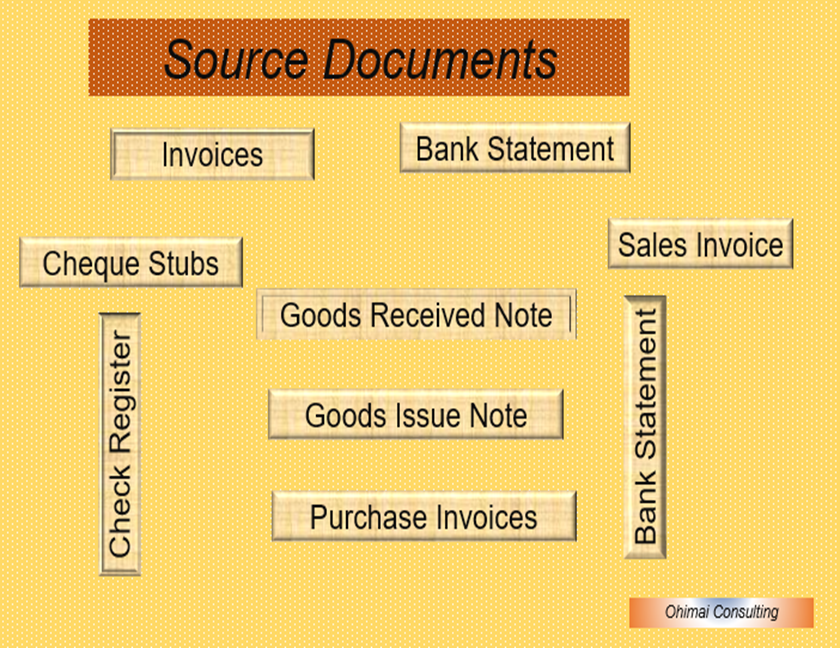
Relevance of Source Documents to organizations cannot be over emphasized. It is important to an accountant and organization in the event of fraud.
Relevance of Source Documents
1. Audit Trail
Audit trail is a set of accounting documents that authenticate the transactions you record in your accounting books. Furthermore, it provides evidence that transaction has occurred. Also, during audit, source documents serve as back up for accounting journals and ledgers. Every business owner is responsible for recording the company’s transactions. Moreover, the relevance of source document to audit trail is such that it must have to include information about what the event was, who created the event, and the day and time the event happened.
2. Full Details of Transactions
It reveals all the basic fact about the transaction such as the amount of the transaction, to whom the transaction was made, the purpose of the transaction. Also, the date of transaction, serial number of the document, name of document such as Local Purchase Order (LPO), receipt, particular of person issuing the document, particular of person authoring the document, name of company/department issuing the document and name of company/department receiving the document.
3. Internal Control System
Internal controls system are the devices, rules, and measures effected by a company. This internal control ensures the integrity of financial and accounting information, uphold accountability, and prevent fraud. Source document is a good internal control mechanism.
4. Assist Accountants
Source documents assist accountants to prepare financial statement which auditor need for investigation. The movement starts from source documents to journalize transactions. In addition, posting is the process of transferring journal entries to the general ledger or subsidiary ledgers, depending on the needs of a company, by account.
5. Reference
In the accounting world, source documents include purchase order, sales invoice, bank statement, and receipts.
Source documents are created any time a business spends or receives money. However, when there is a report of any investigation into a transaction says fraudulent withdrawal from the bank, the bank statement which is one of the source documents will serve as reference point.
6. Correct Errors
Sources document one will be able to verify whether or not an accounting entry is accurate or correct. It is used to correct errors and omission of transactions. Also, situation where staff will deliberately omit or cause error to occurred will be detected with the investigation of the source documents.
7. Reconciliation
Source documents helps to reconcile with the balances in accounts to see if some documents have not been recorded. Also, if some transactions recorded in the accounts do not appear to have any supporting documents. Frequent reconciliation of account will help to reduce fraudulent activities.
Conclusion.
The relevance of source documents to checkmating fraud is such that organization will need to monitor. That will ensure the right thing is done with the available resources.
There are basic assumptions which underline the preparation of financial statements of business enterprise. There are stated below:
Going concern concept: accounting assumes that the business will continue to operate for a long period of time. In other words, it means continuity in business or Continuity Assumption.
The continue preparation of financial statement in accordance with International Financial Reporting Standard (IFRS) is an evidence of going concern. Even the auditor may also carry out investigation see that the going concern is intact.
Example of going concern is prepayment and accrual of expenses. The company accept these expenses because they believe the business will continue to run. If for example any part or section or department or product line is discontinue, it does not means there is no longer a going concern. Going concern is for the entire company.
During Covid19, a lot of companies had financial issues and were unable to pay their obligation. Various government gives those companies a bailout and a guarantee of all payments to creditors. The companies are a going concern despite of its current weak financial position. But if government imposes a restriction on the manufacture of a certain goods and service for the period say 1 year. Then the company will no longer be a going concern since they might not be able to sell any product.
2. Entity concept: This accounting concept separates the business from its owner. Meaning the business is a legal entity. It can sue and be sued. It also means the owners of a business are limited to how much he has invested not his personal resources. So for example, if the owner brings in additional capital into the business, we will treat this as a liability on the balance sheet of the business.Entity concept ensures that each company is tax separately.
Let look at these examples, Mrs. Ese bought a building having 5 office space for $5000 per month. She uses three office for his business and two for personal purpose. In line with business entity concept, only $3,000 (the rent of two offices) is a valid expense of the business
Another example is when owner of a business lends loan to his company. It would be strictly recorded as a liability and that has to be paid back to the owner.
3. Matching Concept:This concept states that the revenue and the expenses of a transaction should be included in the same accounting period. So to determine the income of a period all the revenues and expenses (whether paid or not) must be included. The matching accounting concept follows the realization concept. First, the revenue is recognized and then we match the costs associated with the revenue. So costs are matched with revenue, the reverse would be an incorrect system.
4. Dual concepts: this says that there are two aspects of accounting. It is represented by the assets of the business and liabilities (i.e. claims against it). Assets =liabilities + capital. So for example. Say the business buys an asset worth N10, 000. So now the Fixed Assets of the company will increase by N10, 000. But at the same time, the bank or cash balance will reduce by N10, 000 and so the transaction will have a dual effect in accounting. And also the Balance Sheet will stay balanced.
5. Realization concepts: in accounting, profit should not be recognized until the goods are passed to the customer.
6. Money measurement concept: Accounting is only concerned with the facts that can be measured in monetary terms with fair degree of objectivity. Accounting does not record that the firm has a bad or good management team, poor morale among staff. So for example, if the company underwent a major management overhaul this would have no effect on the accounting records. This concept is actually one of the major drawbacks of accounting.
7. Accrual concept: Revenue and cost are usually recorded in accounts when they are earned or incurred rather than when the money is received or paid.
8. Full Disclosure Concept: This concept states that all relevant information will be disclosed in the accounting statements. A lot of external users depend on these financial statements for their information to make investing decisions. So no information/transactions etc of relevance to any one of them will be omitted from these statements for the benefit of the company.
9. Cost Concept: This accounting concept states that all assets of the firm are entered into the books of account at their purchase price (cost of acquisition + transport + installation etc). In the subsequent years to, the price remains the same (minus depreciation charged). The market price of the asset is not taken into consideration.
10. Accounting Period Concept:Every organization, according to its needs, chooses a specific period of time to complete an accounting cycle. Generally, the time chosen is a year we call the accounting year. The time period is mentioned in the financial statements.
11. Substance over form: usually transactions are recorded and accounted for by their commercial realities rather than their legal form. Substance over form is an accounting concept which means that the economic substance of transactions and events must be recorded in the financial statements rather than just their legal form in order to present a true and fair view of the affairs of the entity.
12. Faithful representation: For financial report to be useful, the financial information must not only represent relevant phenomena but must faithfully represent the phenomena that it purports to represent.
13. Timeliness: It means having information available to decision makers in time to be capable of influencing their decisions. The older the information the less important it become.
14. Relevance: Relevant information is capable of making a difference in the decisions made by users.
15. Comparability: The information about a firm is more useful if it can be compared with similar information about other enterprise and with similar information about the same enterprise for another period or date.
Certified Public Accountant: These are upper-level accountants who are recognized as experts in an organization’s accounting records, taxes and financial standing. They play the role of a trusted advisor, helping their clients plan and meet their financial goals, while also assisting in other fiscal matters. This could include audits and reviews, forensic accounting, consulting and/or litigation services.
2
Forensic accountant: Forensic accountants are the detectives of the accounting world. These professionals analyze financial records to ensure they’re compliant with standards and laws. Conversely, forensic accountants are brought in to uncover errors, omissions or outright fraud.Forensic accountant: Forensic accountants are the detectives of the accounting world. These professionals analyze financial records to ensure they’re compliant with standards and laws. Conversely, forensic accountants are brought in to uncover errors, omissions or outright fraud.
3
Auditor: Auditors are the accuracy experts in an organization. Many organizations, from commercial businesses to non-profits, are required to conduct an annual audit to ensure records are precise.
4
Management accountant: It’s the responsibility of management accountants to provide this information so that sound decisions can be made regarding a company’s future. Some common duties of a management accountant are planning and budgeting, external financial reporting, risk management, profitability analysis and much more.
5
Cost accountant: They are responsible for examining every expense associated with a company’s supply chain to conduct a profitability analysis and budget preparation.
6
Government accountant: Accountant in federal, state and local government. They need accountants to keep track of money.
7
Project accountant: A project accountant is one who works on a project-by-project basis. This person oversees all aspects of a project that might affect the overall cost, including preparing and collecting invoices, approving expenses, verifying employees’ billable hours, planning and maintaining budgets and ensuring the team is meeting project deadlines.
8
Investment accountant: Investment accountants work in the fast-paced fields of finance and investment. Investment accountants typically work for brokerage and asset management firms.
9
Staff accountant: Staff accountant is one of the most common job titles in the field-they are the generalists of the accounting world. They have a wide variety of responsibilities, which can include preparing financial statements, maintaining a company’s general and subsidiary accounts, performing account reconciliations, maintaining payroll records, cash management and supervising clerical employees. By Ojeaburu, Friday, ACA, MSc
This can also be called legal instrument designed to regulate accounting functions:
The constitution of federal republic of Nigeria: This is a document that has supreme authority over the use of the financial resources of the federation. It covers power and control over public fund, establishment of fund e.g. CRF, DF, CF& Federation account, audit of public account, public revenue of federation.
Financial regulation: These are rules governing the management of public fund. It states all the dos and don’ts with regards to public sector accounting.
Appropriation acts: This is an act or law passed by the national assembly or local government which gives statutory authority for the necessary spending from the CFR. Appropriation Act provides authority for spending public money for services to be tendered during the year to which it applies. Appropriation act is approved budget by National Assembly. Appropriation Acts are made every year for the purpose, not just for controlling financial and accounting matters, but primarily to cater for issues such as finance as deemed fit for the recurrent expenditure. The bills passed into laws by the legislature are in two categories: (i) Money bills, and (ii) Other bills (being non-money bills). A bill as defined in (a) above when passed is known as an Appropriation Act while the one as defined in subsection (b) is a Financial Act.
Treasury and financial circular: They are extra administration instruments that are employed for the amendment or modification of the available provisions of financial regulations, civil service rules and the introduction of new policy guidelines. These are issued from time to time as occasions demand which deal with revision of procedures, changes in regulations or amendments to the FRS, changes in formats revision of salaries and fringe benefits, budget preparation and budgetary control etc.
The audit act of 1958 as amended: This Act deal with the duties of Auditor General for the Federation and spells out the account which the Accountant General of the Federation should prepare and present for audit. The Acts empower the Auditor General to prepare and transmit a report to the legislature. It gives him the latitude to inquire into any issue, programme, project, activity, function or transaction.
The financial control and management act 1958 as amended: This document contains provisions for the management, operation, and control of all government funds created by the constitution or by the Act itself. It provides for cash basis accounting, government portfolio, the accounting format for the preparation of government accounts and statements.