
Financial Modelling Fundamentals for Beginners
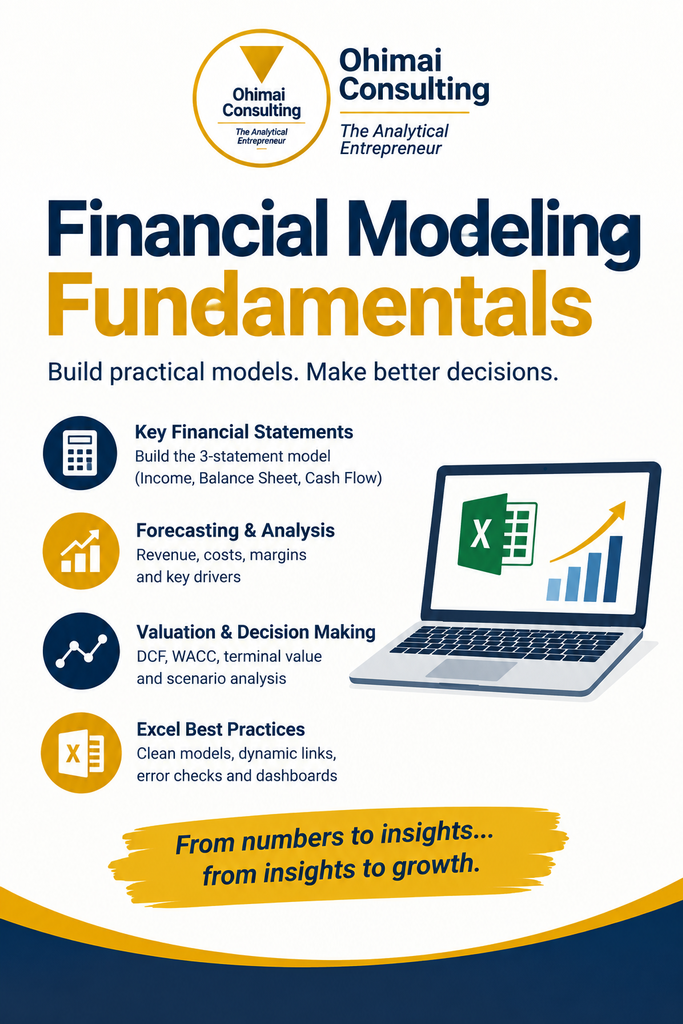
key Course Objectives of Financial Modelling Fundamentals
At the end of this module, participants will be able to:
• Understand financial modelling concepts
• Design professional Excel models
• Structure financial models using international standards
• Apply Excel best practices
• Build dynamic and error-free models
• Document models professionally
• Develop reusable financial modelling templates
Financial Modelling Definition
It is essential to note that Financial Modelling is the process of creating a spreadsheet. This is usually in Microsoft Excel that represents the financial performance of a business, project, or investment. In addition, it converts assumptions into financial statements for decision making.
Why Organizations Use Financial Models
of course, organizations use financial models for
• Business planning
• Budget preparation
• Forecasting
• Investment appraisal
• Loan applications
• Company valuation
• Acquisition of Business
• Risk analysis
• Pricing
• Decision making
A financial model answers questions such as, but not limited:
• Should we invest?
• Will the company make profit?
• What happens if sales reduce by 20%?
• Can we repay our loan?
• Additionally, How much cash will we have?
Some Types of Financial Modelling
1 Three Statement Model
Contains
Income Statement
Balance Sheet
Cash Flow
Used by
• Banks
• Corporates and also by
• Consultants
2 Budget Model
Used for annual budgeting.
Example
2027 Budget
Sales
Expenses
Capital Expenditure
Cash Flow
3 Forecast Model
Predicts future performance.
Example
Forecast next five years.
4 Discounted Cash Flow (DCF) Valuation Model
Calculates company value.
Used by
Investment banks
Private equity
Investors
Characteristic of a Good Financial Model
A professional model should be
• Reliable
• Flexible
• Transparent
• Dynamic
• Simple
• Well documented
• Easy to audit
• Error free
• Scalable
• Reusable
Workbook Structure for Financial Model for Beginners
A professional workbook contains
• 01 Cover
• 02 Instructions
• 03 Assumptions
• 04 Revenue
• 05 Costs
• 06 Depreciation
• 07 Working Capital
• 08 Financial Statements
• 09 Valuation
• 10 Dashboard
• 11 Charts and also
• 12 Checks
Cover Sheet
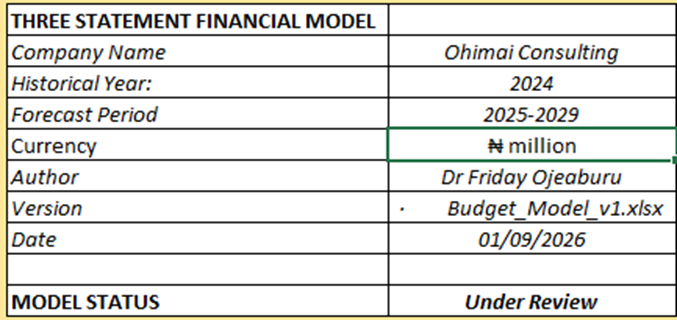
Cover sheet is the first sheet in financial model for beginners. However, one of the key information that is contain on the cover sheet is the version. Furthermore, the information here is not limited to the image
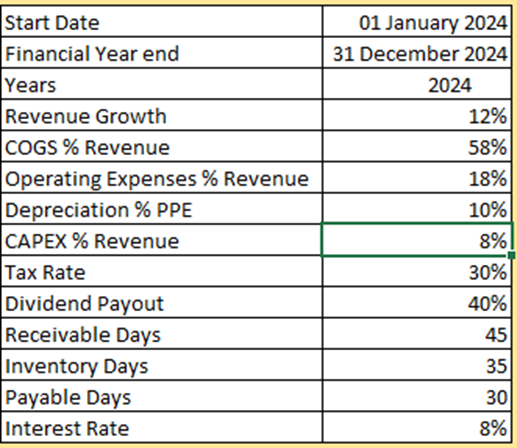
Assumption Sheet
Assumption is the engine room of every financial model. Moreover, this is an input sheet that gives expectation about the future of the Model.
Module 1 Video on Excel Financial Modelling Fundamentals for Beginner.
For the full training on this module 1, you need to watch me video below. Watch my videos on Financial Modelling Fundamentals posted on YouTube. Moreover, also make effort to watch several videos on my YouTube.
In this video, i demonstrated an overview of the structure of a good excel financial modelling. In addition, this is a training video that dealt with the complete training on financial modelling. This is video is the module 1, and ensure you watch the next module.
Call for One on one Training
If you need training on Excel Financial Modelling, contact me on this links.
Gumroad : https://ohimaiconsulting.gumroad.com/l/exceltraining
WhatsApp Channel: https://whatsapp.com/channel/0029Vak80a8CBtx599CCrz0f
Training Course: https://ohimaiconsulting.com/?page_id=209261